How do Top Performing Law Firms optimize their websites for AI and Clients in 2026?
TL;DR — You can optimize the three primary CWV metrics through the following technical strategies:
Largest Contentful Paint (LCP): Perceived Load Speed
- The target for LCP is 2.5 seconds or fewer
- Use modern image components for automatic image optimization and serve images in WebP or AVIF formats.
Interaction to Next Paint (INP): UI Responsiveness
- The target for INP is 200 milliseconds or fewer
- Deploy code-splitting and use async or defer loading for all non-critical scripts
Cumulative Layout Shift (CLS): Visual Stability
- The target for CLS is 0.1 or lower
- Hardcode width and height attributes for all images and video elements to reserve space on the page before they load
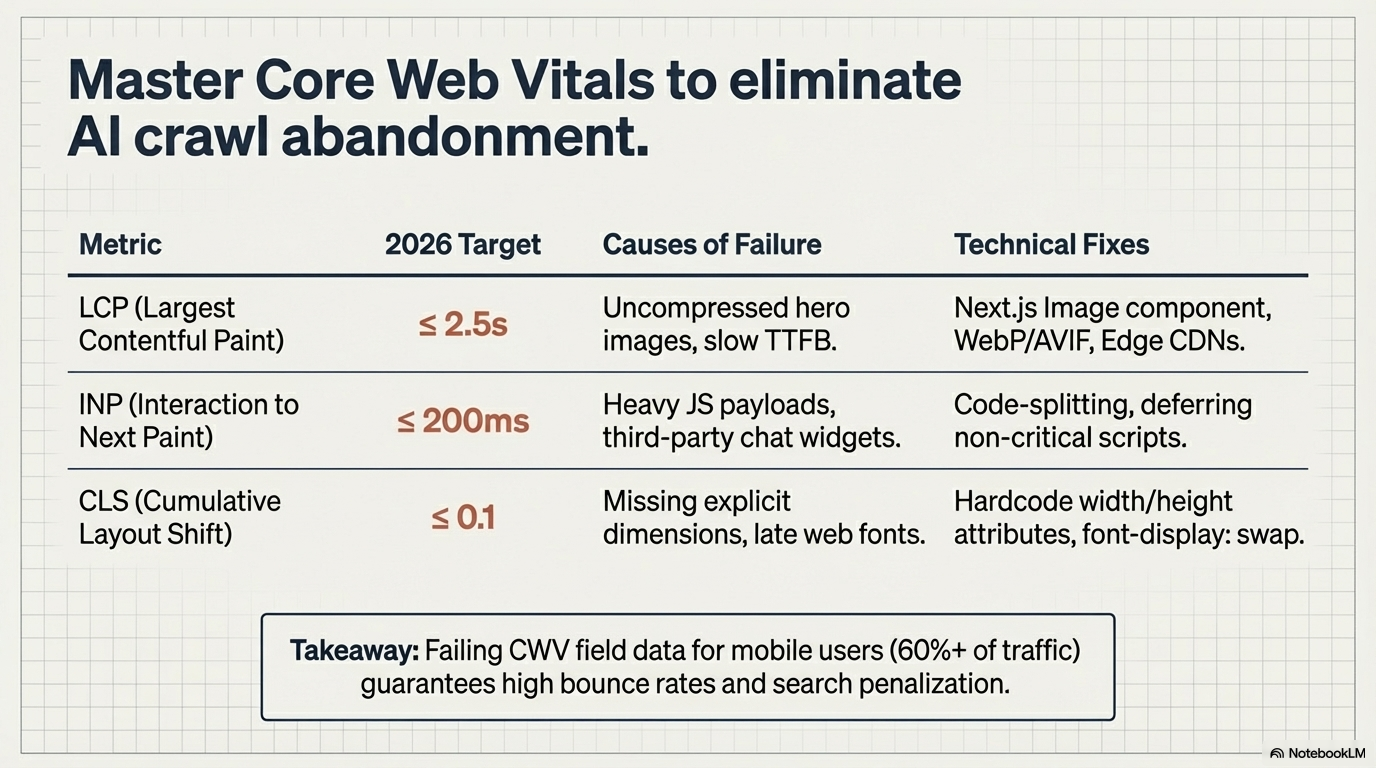
Optimizing Core Web Vitals (CWV) for attorney websites is critical in 2026, as these empirical benchmarks serve as foundational ranking factors that influence up to 40% of search visibility. To maintain a competitive digital presence, firms must achieve “Good” ratings across field data for mobile users, who represent over 60% of legal search traffic.
Based on the sources, you can optimize the three primary CWV metrics through the following technical strategies:
1. Largest Contentful Paint (LCP): Perceived Load Speed
The target for LCP is 2.5 seconds or fewer. Failures in this area are typically caused by uncompressed hero images, slow server response times (TTFB), or render-blocking CSS and JavaScript.
Implementation Strategy: Use modern image optimization components for automatic image processing and serve images in WebP or AVIF formats.
Technical Fixes: You should inline critical CSS and utilize edge Content Delivery Networks (CDNs) to ensure the main content block loads almost instantly.
2. Interaction to Next Paint (INP): UI Responsiveness
The target for INP is 200 milliseconds or fewer. This metric measures how quickly a page responds to user inputs like clicks or keyboard taps; it is often degraded by heavy JavaScript payloads and excessive third-party widgets, such as live chat tools.
Implementation Strategy: Deploy code-splitting and use async or defer loading for all non-critical scripts.
Technical Fixes: Defer third-party trackers and optimize event handlers to prevent long main-thread tasks. Utilizing server-side rendering can further reduce the volume of client-side JavaScript, ensuring immediate responsiveness.
3. Cumulative Layout Shift (CLS): Visual Stability
The target for CLS is 0.1 or lower. Layout shifts occur when elements move unexpectedly during the loading phase, often due to missing dimensions on images or late-loading web fonts.
Implementation Strategy: Hardcode width and height attributes for all images and video elements to reserve space on the page before they load.
Technical Fixes: Pre-allocate space for dynamic elements like banners or ads, and use font-display: swap to prevent shifts caused by late-loading web fonts.
The Architectural Foundation
Beyond these specific fixes, our exhaustive research and personal experience leads us to recommend transitioning to a decoupled, headless architecture using modern frameworks like Astro and TanStack to establish a high-performance baseline. This approach allows for Static Site Generation (SSG) to serve pre-built HTML globally via CDNs and Incremental Static Regeneration (ISR) to update dynamic content like attorney bios in the background without sacrificing speed. By eradicating rendering bottlenecks, firms ensure that both human prospects and AI crawlers can instantly access and index their content.